
Artificial Intelligence & Data Science
UG Courses


Artificial Intelligence & Data Science
Introduction
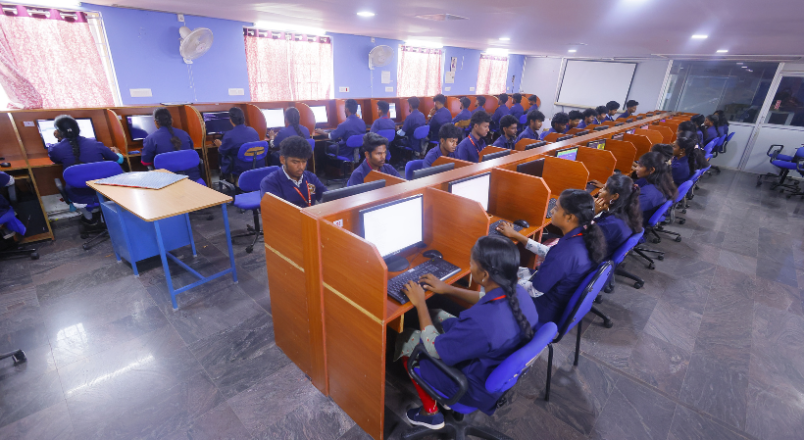
The B.Tech program in Artificial Intelligence & Data Science is designed to equip students with a strong foundation in basic sciences, mathematics, artificial intelligence, and data science. The program aims to cultivate technical skills for research and development of disruptive solutions in the field. It emphasizes logical thinking, lifelong learning, collaboration, ethical behavior, and innovation to address real-world challenges and contribute to economic development.
Vision & Mission
Vision
To become a centre of excellence in the realms of Artificial Intelligence and Data Science which fosters talents, cultivates research skills and promotes social responsibility.
Mission
- Foster employability and entrepreneurial skills in AI & DS through experiential and self-directed learning.
- Strive towards efficient industry-institute interaction to bridge the gap between academic learning and industry needs.
- Sensitize students to solve societal issues through AI techniques while inculcating values and ethics.
- Train students in the state-of-the-art technologies of AI & DS.
Programme Educational Objectives (PEOs)

Apply the fundamental knowledge of basic sciences, mathematics, computer science, artificial intelligence, and data science to address socially significant challenges.
Collaborate within multi-disciplinary teams, convey ideas proficiently, and create top-tier solutions using the expertise acquired through continuous lifelong learning.
Exhibit ethical principles, uphold values, maintain integrity, and deliver inventive solutions throughout their professional endeavors.
Engage in advanced studies and research within the realms of Artificial Intelligence and Data Science.
Programme Specific Outcomes (PSOs)
After the successful completion of the program, the graduates will be able to:
- Apply the artificial knowledge in expert systems, natural language processing, speech recognition and machine vision.
- Focus on cognitive skills that include learning, reasoning, self-correction and creativity.
Program Outcomes (POs)
Engineering Knowledge
Apply the knowledge of mathematics, science, engineering fundamentals, and an engineering specialization to the solution of complex engineering problems.
Problem Analysis
Identify, formulate, review research literature, and analyze complex engineering problems reaching substantiated conclusions using first principles of mathematics, natural sciences, and engineering sciences.
Design / Development of Solutions
Design solutions for complex engineering problems and design system components or processes that meet the specified needs with appropriate consideration for public health and safety, and cultural, societal, and environmental considerations.
Conduct Investigations of Complex Problems
Use research-based knowledge and research methods including design of experiments, analysis and interpretation of data, and synthesis of information to provide valid conclusions.
Modern Tool Usage
Create, select, and apply appropriate techniques, resources, and modern engineering and IT tools including prediction and modelling to complex engineering activities with an understanding of the limitations.
The Engineer and Society
Apply reasoning informed by contextual knowledge to assess societal, health, safety, legal and cultural issues and the consequent responsibilities relevant to professional engineering practice.
Environment and Sustainability
Understand the impact of professional engineering solutions in societal and environmental contexts, and demonstrate the knowledge of, and need for sustainable development.
Ethics
Apply ethical principles and commit to professional ethics, responsibilities, and norms of engineering practice.
Individual and Team Work
Function effectively as an individual, and as a member or leader in diverse teams and multidisciplinary settings.
Communication
Communicate effectively on complex engineering activities with the engineering community and society at large through reports, documentation, presentations, and clear instructions.
Project Management and Finance
Demonstrate knowledge and understanding of engineering and management principles and apply these as a member or leader in a team to manage projects and multidisciplinary environments.
Life-long Learning
Recognize the need for, and have the preparation and ability to engage in independent and life-long learning in the broadest context of technological change.
Course Details
The B.Tech program in Artificial Intelligence & Data Science typically covers a range of subjects, including but not limited to:
- Mathematics for AI & DS
- Programming and Algorithms
- Machine Learning
- Data Structures
- Artificial Intelligence
- Data Mining
- Natural Language Processing
- Big Data Analytics
- Deep Learning
- Business Intelligence
- Ethics in AI & DS
- Research Methodology
The curriculum is designed to provide students with a comprehensive understanding of both theoretical concepts and practical applications in Artificial Intelligence and Data Science.
Faculty Information








Lab Facility
Facility
Project
Events
Placement
Graduates in Artificial Intelligence & Data Science have diverse career opportunities in various industries. Some potential career paths include:
-
Data Scientist:
Analyzing and interpreting complex data sets to inform business decision making. -
Machine Learning Engineer:
Developing and implementing machine learning algorithms and models. -
AI Researcher:
Conducting research in Artificial Intelligence to advance the field. -
Data Analyst:
Extracting valuable insights from data to support business strategies. -
Business Intelligence Analyst:
Analyzing business data to help companies make informed decisions. -
AI Consultant:
Providing expertise to businesses on the implementation of AI solutions. -
Big Data Engineer:
Managing and analyzing large volumes of data for business insights. -
Natural Language Processing Engineer:
Working on technologies that enable computers to understand and process human language. -
Research Scientist:
Contributing to research projects in the field of Artificial Intelligence and Data Science. -
Entrepreneurship:
Starting your own venture in AI & DS, developing innovative solutions and products.
The program aims to prepare students for the rapidly evolving field of Artificial Intelligence and Data Science, providing them with the skills and knowledge needed to thrive in this dynamic and high-demand industry.
| S.NO | LABORATORY |
|---|---|
| 1 | Problem Solving and Python Programming Laboratory |
| 2 | C Programming Laboratory |
| 3 | Data Structures Laboratory |
| 4 | Object Oriented Programming Laboratory |
| 5 | Database Management Systems Laboratory |
| 6 | Operating Systems Laboratory |
| 7 | Object Oriented Analysis and Design Laboratory |
| 8 | Networks Laboratory |
| 9 | Internet Programming Laboratory |
| 10 | Cloud Computing Laboratory |
| 11 | Security Laboratory |