
Electronics and Communication Engineering
UG Courses


Electronics and Communication Engineering
Introduction
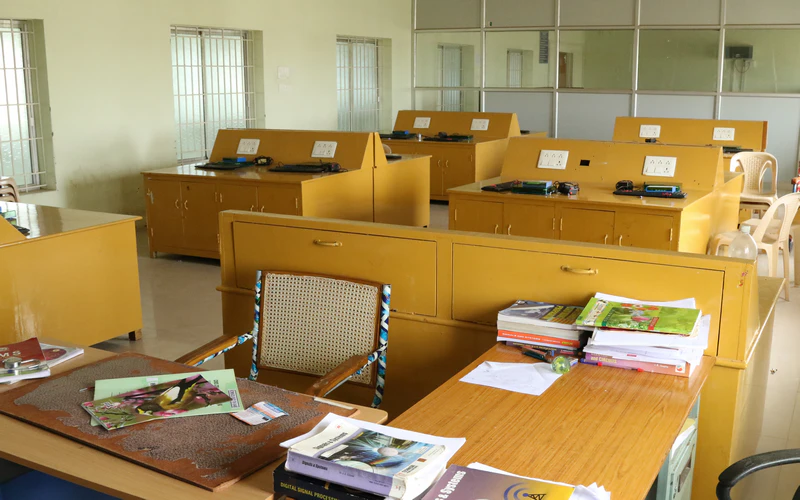
The Bachelor of Engineering in Electronics and Communication Engineering (ECE) is designed to prepare students for a broad range of engineering studies and career paths. ECE encompasses various fields such as business, biomedical engineering, computer hardware and software, aerospace, nanoelectronics, photonics, robotics, and renewable energy. The program aims to equip students with the skills and knowledge needed to address the challenges of the rapidly advancing technological landscape.
Vision & Mission
Vision
To achieve excellence in the realms of education and research within the field of Electronics and Communication Engineering.
Mission
- To impart knowledge using cutting-edge technologies, addressing the evolving challenges of the industry.
- To conduct research through collaboration with research organizations and industry stakeholders.
- To empower students with robust foundations to prepare them for further education.
Programme Educational Objectives (PEOs)
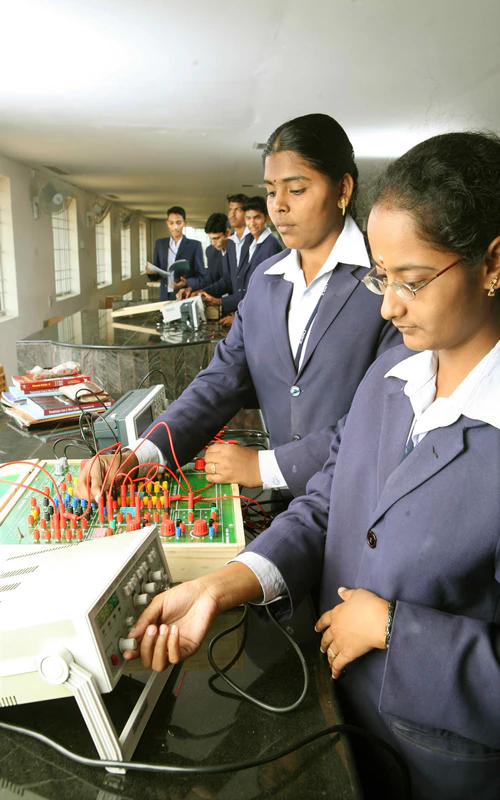
Empowered to pursue research, establish successful careers in academia or industries related to Electronics and Communication Engineering, or embark on entrepreneurial ventures.
Apply robust foundational concepts as well as advanced techniques and tools in constructing solutions or systems of diverse complexities.
Critically analyze literature in a specialized area and ethically devise innovative, research-oriented methodologies to address identified problems.
Programme Specific Outcomes (PSOs)
After the successful completion of the program, the graduates will be able to:
- To design and develop solutions by applying fundamental principles of electronics and communication engineering.
- To adapt to the latest developments in information and communication technology.
Program Outcomes (POs)
Engineering Knowledge
Apply the knowledge of mathematics, science, engineering fundamentals, and an engineering specialization to the solution of complex engineering problems.
Problem Analysis
Identify, formulate, review research literature, and analyze complex engineering problems, and reach substantiated conclusions using first principles of mathematics, natural sciences, and engineering sciences.
Design / Development of Solutions
Design solutions for complex engineering problems and design system components or processes that meet specified needs with appropriate consideration for public health and safety, as well as cultural, societal, and environmental factors.
Conduct Investigations of Complex Problems
Use research-based knowledge and methods including design of experiments, analysis and interpretation of data, and synthesis of information to provide valid conclusions.
Modern Tool Usage
Create, select, and apply appropriate techniques, resources, and modern engineering and IT tools, including prediction and modelling, to complex engineering activities with an understanding of their limitations.
The Engineer and Society
Apply contextual reasoning to assess societal, health, safety, legal, and cultural issues and the consequent responsibilities relevant to professional engineering practice.
Environment and Sustainability
Understand the impact of engineering solutions in societal and environmental contexts and demonstrate knowledge of sustainable development.
Ethics
Apply ethical principles and commit to professional ethics, responsibilities, and norms of engineering practice.
Individual and Team Work
Function effectively as an individual, and as a member or leader in diverse and multidisciplinary teams.
Communication
Communicate effectively on complex engineering activities with the engineering community and society at large, including reports, documentation, presentations, and clear instructions.
Project Management and Finance
Apply engineering and management principles to manage projects as an individual or in teams, including multidisciplinary environments.
Life-long Learning
Recognize the need for and engage in independent and lifelong learning in the context of technological change.
Course Details
The Electronics and Communication Engineering program covers a broad range of subjects, including but not limited to:
- Electronic Circuits
- Communication Systems
- Digital Signal Processing
- Microprocessors and Microcontrollers
- VLSI Design
- Wireless Communication
- Embedded Systems
- Photonics and Optoelectronics
- Robotics
- Renewable Energy Systems
Faculty Information






Lab Facility
Facility
Project
Events
Placement
Graduates of the BE Electronics and Communication Engineering program have diverse career opportunities in various industries, including:
-
Telecommunications:
Design and maintenance of communication systems and networks. -
Electronics Industry:
Development and manufacturing of electronic components and devices. -
Information Technology:
Roles in IT companies focusing on hardware, software, and network solutions. -
Aerospace and Defense:
Involvement in the design and maintenance of electronic systems in aerospace and defense. -
Biomedical Engineering:
Application of electronic systems in the development of biomedical instruments. -
Renewable Energy:
Design and implementation of systems for harvesting and distributing renewable energy. -
Robotics and Automation:
Design and implementation of robotic systems for various applications. -
Research and Development:
Opportunities in R&D labs and institutions working on cutting-edge technologies.
The program is designed to empower students to contribute to technological advancements and address the challenges of the modern world.