- +91-8825438474
- ceo@absgroups.co.in / marketing@absgroups.co.in
We Provide Chemicals and water treatment plant supplier

Descaling & Cooling Tower Service
The objective of pre-operational chemical cleaning and flushing is to remove debris such as silt, sand, scale, iron oxide deposits, welding slags, and other contaminants present in a new pipework system.
This process is critical because if contaminants remain in the system, they directly affect cooling efficiency and reduce flow. These impurities also prevent the formation of uniform protective passivation layers, leading to corrosion within the system.
Therefore, it is essential to ensure that a proper pre-operational cleaning and flushing program is completed before the system is put into normal operation.
Chemical cleaning and flushing can be carried out using either system inline pumps or external temporary pump systems.
External temporary pump systems are generally preferred, as inline pumps may get damaged due to contaminants present in the pipeline.
The method also depends on system size. Large systems, such as district cooling systems, require large volumes of water and generate significant wastewater. Therefore, the cleaning method is selected based on system type and capacity.
Ensure continuous fresh water supply availability
Ensure availability of power and electricity
Ensure manpower availability (24-hour basis)
Check dosing pumps installation and working condition
Ensure required chemicals are available at site
Confirm disposal methods/area availability
Verify installation work completion
Identify feed and drain points clearly
Provide drain from lowest point
Ensure hydrostatic testing of pipelines
Ensure PPE and safety equipment availability
Check circulation pumps operation
Check temporary feed pump operation
Verify pump connections to system circuit
Identify all air vents in the system
Bypass sensitive equipment
Ensure isolating valves are open
Remove precision valves
Ensure contractor supervision during process
Close all drain valves opened during flushing. Clean and reinstall strainers, then dose chemicals into the system.
Circulation pumps are operated until total iron levels stabilize. Once constant levels are reached, notify the consultant/MEP engineer for inspection.
Stop circulation, drain the system completely, and collect samples for records.
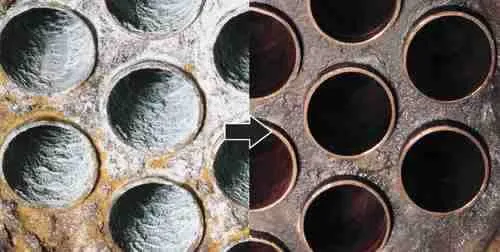
ABS 205 is a concentrated heavy-duty descaling compound used to remove scale, slime, rust, and other sediments. It is effective on most metal surfaces and ideal for removing carbonate scales and concrete residues without damaging paint.
It contains corrosion inhibitors to protect metal surfaces and is highly economical.
Recommended dilution ratio: 1:10 with water.